Here we are in the dying hours of 2008, many people will be look back thinking that this was not a great year, how times were so much better earlier in the decade and how 2009 will simply be worse on all fronts.
But 2008 could also be looked at as being the great cleanser - the year that people behind the easy money got found out and the rest of us got educated about the fact that if there is a fast buck to be made then almost inevitably, in the long term, there is some cost. Unfortunately the cost has been borne by many people, not necessarily those who made the fast buck in the first place.
2009 will be a year in which those who believe in ethical ways of conducting life - and business - can come forward with confidence and make a stand against those who present the more enticing, exciting options. Of course many businesses need to innovative and take risks - and there the risk takers will get their way but the new ethic of risk taking should be that the risk taker sees the losses when it goes wrong and there is little or no 'collateral damage'. The age of banks taking risks in such a way that every one of us sees the after effect when the quest for the fast buck goes wrong must be behind us.
While Gordon Brown might not turn out to be the person who saves the world, in 2009 there will be the great new hope for the planet - in the shape of Barack Obama. His ethics and idealism seem to be just what we need - the issue is whether he will be strong enough to overcome the entrenched interests of those who got us into this mess. For those who might otherwise look forward to 2009 with nothing but pessimism, Obama presents the potential for a new ethical outlook from the top and exciting changes that could touch us all.
Things might be tough along the way but 2009 will be the year of the new clean slate, a year of opportunity for us all to bring the excesses under control and put in place firm foundations for future growth.
Wednesday, 31 December 2008


Monday, 22 December 2008
A very merry Christmas!
We're about to print our last t-shirts for this year and we do so with the feeling of quiet contentment that goes with completing a job well done - and also a feeling of relief and exhilaration at being able to forget about it all for a few days spent with families and friends.
Fortunately the team here do not have far to go. No long drives across the width or height of the UK in order to be with those closest to us - we're able to pop out to the local and have a final drink together before saying our farewells and meeting up again in the new year.
At the pub we might chat about our achievements this year, not just in terms of our growth but also in terms of being able to do so on the back of continuing to promote the ethical and environmental causes in which we believe. We might chat about how the recession might affect the promotional clothing industry and the steps that we can take so that next year we do as well as this year. We might consider what new technologies might come along to help us meet these challenges.
On the other hand, in the quiet knowledge that we've been dealing with these all issues in the workplace, what we'll probably do is what we normally do when we get to the pub - talk complete and utter bo!!ocks about music, football and anything else that comes to mind except Strictly Come Dancing!
With that profound thought we pass our readers - whether customers past or future - or simply readers - our very best wishes that the festive season brings joy and happiness to you and your loved ones!
Fortunately the team here do not have far to go. No long drives across the width or height of the UK in order to be with those closest to us - we're able to pop out to the local and have a final drink together before saying our farewells and meeting up again in the new year.
At the pub we might chat about our achievements this year, not just in terms of our growth but also in terms of being able to do so on the back of continuing to promote the ethical and environmental causes in which we believe. We might chat about how the recession might affect the promotional clothing industry and the steps that we can take so that next year we do as well as this year. We might consider what new technologies might come along to help us meet these challenges.
On the other hand, in the quiet knowledge that we've been dealing with these all issues in the workplace, what we'll probably do is what we normally do when we get to the pub - talk complete and utter bo!!ocks about music, football and anything else that comes to mind except Strictly Come Dancing!
With that profound thought we pass our readers - whether customers past or future - or simply readers - our very best wishes that the festive season brings joy and happiness to you and your loved ones!
Monday, 15 December 2008
The smartest young scientists wear Pier 32!!
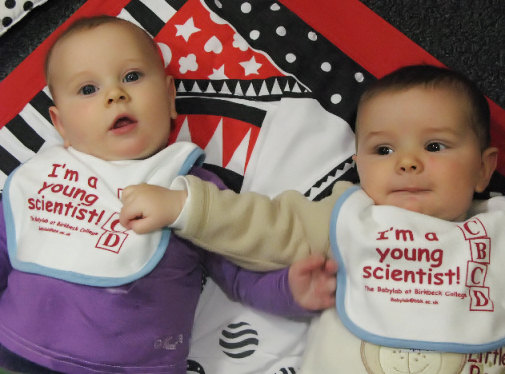
It's too easy to think that Pier 32 is just about custom promotional t-shirts. But that's far from the full truth - we supply all sorts of promotional clothing, from outerwear to vests. You can also have us customise accessories such as tote bags and, in the case of children, bibs. Which is where another of our customers, the Centre for Brain and Cognitive Development comes in.
The Centre for Brain and Cognitive Development (CBCD) was founded at Birkbeck College, University of London, in 1998. It has grown steadily and is now internationally recognised as one of the leading centres of its kind. Its mission is to investigate relations between postnatal brain development and changes in perceptual, cognitive, and linguistic abilities from birth through childhood and late adulthood.
For adult volunteers, behavioural studies usually take up to 30 minutes and involve watching sequences of pictures or listening to sounds and making judgments about them. With such experiments the Centre study the response time and accuracy of participants to clarify the thought processes (such as attention or working memory) involved in the task.
Many studies at the Centre use EEG (electroencephalography). This is a safe and non-invasive method of studying brain electrical activity through a net of sensors placed on a participant's head. The sensors pick up tiny electrical signals that can then be processed to learn more about the pattern of brain activity during the experimental task, (for example judging the similarity of 2 pictures, or detecting previously unseen faces). This technique can be used to answer many different questions. How does the brain extract different bits of information about a face? What happens in the brain when you see a novel image? Do left and right hemispheres process different kinds of information?
The Centre also incorporates the Babylab - which is where our bibs come in! The Babylab studies how babies learn and develop, particularly during the first 2 years of life. Some of the areas investigated include how babies recognise faces, how they learn to pay attention to some things and not others, how they learn to understand what other people do and think, and how their language and understanding of the world develops.
Generally studies take the form of simple games in which babies are presented with various interesting things to look at and listen to. Like short video clips or cartoons on a computer screen or more interactive studies involving showing the babies different toys or objects. A researcher might play a game with a baby to understand more about how they think and learn different skills. In addition to studies where they simply observe babies behaviour they also use various methods for measuring brain activity including the EEG 'hairnet' of sensors and the following of eye movements.
As well as studying typical brain development in infancy, the Babylab is one of the only laboratories in Europe that studies brain functioning in very young children with autism and William’s Syndrome.
We have supplied T-Shirts & Bibs sized for babies of 3 - 24 months to the babylab - and on the front is printed the motto: "I'm a young scientist" - never too young to start!
The centre is continuously looking for adult volunteers between 18 and 35 years old to take part in behavioural studies as well as in studies on brain activity, and babies in their first two years. Visit their website to sign up.
Sadly most of us here at Pier 32 are far too old to have the Centre delve into our psyche...
Thursday, 11 December 2008
The Great Gorilla Run 2008

During the early hours of 27 September a blanket of mist settled over London and the city was at peace. But not for long... as the sun's rays began to break through, hundreds of gorillas emerged from London's streets and a gorilla gathering started to form in the city. This was the 2008 Great Gorilla Run and it was set to be amazing.
By 10:30am over 732 dedicated Gorilla Organization supporters, dressed in their customised gorilla costumes had gathered at the start of the run in central London. This was the first time in history that this number of people dressed as gorillas had gathered in one place making the 2008 Great Gorilla Run a record breaking event! Wildlife conservationist and television presenter Bill Oddie was in great spirits and after an exciting build up, set the gorilla runners off along the 7km route.
As the gorillas spread through the streets of London thousands of onlookers gathered and TV crews from around the world captured the moment on film.
To date over £250,000 has been raised by gorilla runners for the endangered gorillas of central Africa - a fantastic achievement. Elizabeth Roberts, who raised over £4000 was this year's top fundraiser and as a big thank you for her efforts, adventure travel company Explore, who sponsored this year's Great Gorilla Run, has offered Elizabeth a once in a lifetime trip to see mountain gorillas in the wild in Uganda.
No, Pier 32 did not supply the Gorilla costumes! Pier32 supplied ethically produced t-shirts from our African supplier Starworld.
To see more pictures from the event, for more information and to sign up for the next Great Gorilla Run on 26 September 2009 visit www.greatgorillas.org. Our congratulations go out to everyone who took part!
Monday, 1 December 2008
Living Streets - reducing the impact of the car
We have just heard how another of our customers has been using our services to project themselves - not just in the UK but again in Europe.
The charity Living Streets campaigns for creating better streets and public spaces to be enjoyed by everyone on foot, with their needs prioritised over traffic. Living Streets also campaigns for more walking on everyday journeys, reducing congestion, pollution and our carbon footprint.
The charity runs various campaigns, a notable one being the Walk to School campaign funded by the Department for Transport and the BIG Lottery Fund. That campaign was recently joined by the Walking Works campaign, encouraging commuters to reduce the number of short car journeys they do (20% of journeys being less than a mile!) and walk to the station or all the way to work, with benefits for fitness and the environment.
While most of our customers order our personalised t-shirts or hoodies, Living Streets wanted customised rucksacks to be taken by a group of students from Darlington (with funding from Darlington Borough Council and Northern Film and Media) to visit the Walk21 conference on walking and public space in Barcelona. They presented their own ideas to delegates about their ideal walks to school, and grilled the experts at the conference. They are currently editing their experiences into a video.

The 5 day experience included travelling to Barcelona and back by sleeper train - quite an experience in itself and rather more beneficial to the environment than flying! As well as attending the conference, they engaged in a range of local activities.
This was all part of the Step Up Debate - a national discussion about what changes students would like to see made to encourage them to walk more of their school journeys.
Our ethical and environmental credentials at Pier 32 was an important part of Living Streets choosing us as a supplier of promotional products. We are pleased to have played our part in helping them achieve their aims.
As well as the Living Streets website at http://www.livingstreets.org.uk/ the Step Up campaign site is at www.stepup.org.uk. At these sites you can not only find out rather more about the charity and its campaigning, but also about the students' experiences on the Barcelona trip.
The charity Living Streets campaigns for creating better streets and public spaces to be enjoyed by everyone on foot, with their needs prioritised over traffic. Living Streets also campaigns for more walking on everyday journeys, reducing congestion, pollution and our carbon footprint.
The charity runs various campaigns, a notable one being the Walk to School campaign funded by the Department for Transport and the BIG Lottery Fund. That campaign was recently joined by the Walking Works campaign, encouraging commuters to reduce the number of short car journeys they do (20% of journeys being less than a mile!) and walk to the station or all the way to work, with benefits for fitness and the environment.
While most of our customers order our personalised t-shirts or hoodies, Living Streets wanted customised rucksacks to be taken by a group of students from Darlington (with funding from Darlington Borough Council and Northern Film and Media) to visit the Walk21 conference on walking and public space in Barcelona. They presented their own ideas to delegates about their ideal walks to school, and grilled the experts at the conference. They are currently editing their experiences into a video.

The 5 day experience included travelling to Barcelona and back by sleeper train - quite an experience in itself and rather more beneficial to the environment than flying! As well as attending the conference, they engaged in a range of local activities.
This was all part of the Step Up Debate - a national discussion about what changes students would like to see made to encourage them to walk more of their school journeys.
Our ethical and environmental credentials at Pier 32 was an important part of Living Streets choosing us as a supplier of promotional products. We are pleased to have played our part in helping them achieve their aims.
As well as the Living Streets website at http://www.livingstreets.org.uk/ the Step Up campaign site is at www.stepup.org.uk. At these sites you can not only find out rather more about the charity and its campaigning, but also about the students' experiences on the Barcelona trip.
Thursday, 20 November 2008
Ethical Brand Profile - Jerzees

Jerzees is a large promotional clothing brand with a higher profile in the USA than in the UK. It's American website is in fact curiously unhelpful to our quest for information on the brands ethical credentials. However Jerzees is one of the brands of the Russell Corporation (Russell itself being the other well known brand) and its European website
is much more helpful as well as being rather more attractive.
Unlike the Jerzees USA website, there is a page devoted to "Our Ethics". "Russell Europe believes worldwide ethical practices and principles are now more important than ever. We work to a strict code of practice to help ensure none of our manufacturing processes put the environment at risk. Equally vital is the welfare of the people who make our garments, wherever they are in the globe."
All the Jerzees garments are Öko-Tex certified (which means no harmful residual chemicals may be in place in the clothing after manufacture and that the environmental impact of the production process itself was minimal). They also say that they are "committed to having all our manufacturers WRAP (Worldwide Responsible Apparel Production) accredited".
Now it's obvious that this means that Jerzees suppliers are not all currently WRAP accredited. I visited the WRAP website to see if that might shed some light. Unfortunately because Jerzees outsources its production and their site does not say where, and WRAP monitors the actual factories not brands, the WRAP organisation is not going to be able to help us.
The Russell Corporation itself was recently acquired by Berkshire Hathaway Inc., which owns Fruit of the Loom. The link is to our separate blog article on Fruit of the Loom where we considered the status of Berkshire Hathaway as the owner of that brand. In that article I mentioned 'high minded ideals' so in that respect the intention of Jerzees to have all its suppliers WRAP certified is good and in keeping with its owner's ideals.
But we'd really like to have more concrete information on how much of Jerzees production is currently WRAP certified and how long it will be before it all is certified. And what is the status of its other suppliers - what standards are applied there?
As ever help on this sort of issue is appreciated from anyone who can shed light on the answers.
Friday, 14 November 2008
Working with Habitat for Humanity
We've a large number of articles in this blog looking at the supply chain in getting t-shirts to us in the UK; it's time to look at the other side of that supply chain, at our customers, how our t-shirts help them and how they in turn help others.
While the clients we supply with clothing are mainly situated here in the UK, the work they do spans the globe. One such client is Habitat for Humanity, an international charity dedicated to the elimination of poverty housing and homelessness around the world. Founded in 1976, and now working in more than 90 countries, Habitat for Humanity have built, repaired or renovated over 300,000 houses in partnership with people in need of safe, decent homes. They run an international volunteering programme, Global Village, where individuals or groups can visit projects and actually work hand in hand with homepartner families to build safe, decent homes.
We got involved with Habitat for Humanity when they were let down by another firm of t-shirt printers. They were soon able to establish our ethical credentials (very important to a charity looking to relieve housing poverty, sometimes in locations where less ethical manufacturing practices may be commonplace) and we were able to supply them with the quality they needed and meet what had become a very tight deadline.
As a result, Habitat for Humanity were able to send their volunteers to a variety of locations where the wearing of the t-shirts by the volunteers helps spread the word about the charity and what they do.

Habitat for Humanity now carries out its work in more than 90 countries around the globe - including most locally two projects in the UK at Liverpool and Southwark. In the image we find our t-shirts being worn by volunteers helping with construction work in Cluj in Romania. The economic and social legacy of years of oppressive rule in a Soviet style economy has left many in Romania without decent shelter. They are forced to live in cold, damp crowded housing, often in high rise apartment blocks, but at the other extreme in older wooden homes that are literally rotting.
What the Habitat programme does is help needy families build their new homes and live in them at a cost that is affordable in the local economy. The homes you see being constructed use a wooden frame structure and sandwich-type walls made of modern thermo-insulating materials. Even though properly heated, living in these homes will use a fraction of the energy of the older drafty colder housing stock still endemic in Romania. The same environmental considerations that helped Habitat for Humanity choose Pier 32 to supply clothing are put into practice in the work they do across the globe.
For more information please visit http://www.habitatforhumanity.org.uk/volunteering.htm.
While the clients we supply with clothing are mainly situated here in the UK, the work they do spans the globe. One such client is Habitat for Humanity, an international charity dedicated to the elimination of poverty housing and homelessness around the world. Founded in 1976, and now working in more than 90 countries, Habitat for Humanity have built, repaired or renovated over 300,000 houses in partnership with people in need of safe, decent homes. They run an international volunteering programme, Global Village, where individuals or groups can visit projects and actually work hand in hand with homepartner families to build safe, decent homes.
We got involved with Habitat for Humanity when they were let down by another firm of t-shirt printers. They were soon able to establish our ethical credentials (very important to a charity looking to relieve housing poverty, sometimes in locations where less ethical manufacturing practices may be commonplace) and we were able to supply them with the quality they needed and meet what had become a very tight deadline.
As a result, Habitat for Humanity were able to send their volunteers to a variety of locations where the wearing of the t-shirts by the volunteers helps spread the word about the charity and what they do.
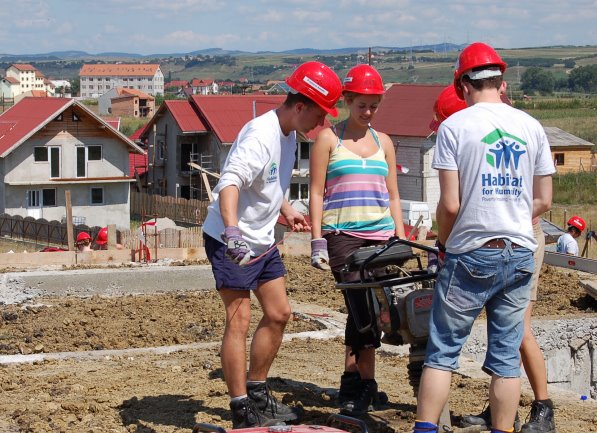
Habitat for Humanity now carries out its work in more than 90 countries around the globe - including most locally two projects in the UK at Liverpool and Southwark. In the image we find our t-shirts being worn by volunteers helping with construction work in Cluj in Romania. The economic and social legacy of years of oppressive rule in a Soviet style economy has left many in Romania without decent shelter. They are forced to live in cold, damp crowded housing, often in high rise apartment blocks, but at the other extreme in older wooden homes that are literally rotting.
What the Habitat programme does is help needy families build their new homes and live in them at a cost that is affordable in the local economy. The homes you see being constructed use a wooden frame structure and sandwich-type walls made of modern thermo-insulating materials. Even though properly heated, living in these homes will use a fraction of the energy of the older drafty colder housing stock still endemic in Romania. The same environmental considerations that helped Habitat for Humanity choose Pier 32 to supply clothing are put into practice in the work they do across the globe.
For more information please visit http://www.habitatforhumanity.org.uk/volunteering.htm.
Thursday, 6 November 2008
Forget the credit crunch, think eco-crunch
Good news! The Bank of England has just cut its base rate by 1.5% meaning that many of us will have a little more money to go around and we might just start to think that things are going to better in a year or so, also making us feel a little better about the here and now.
That rate cut shaves no less than one third off the base rate. Just like that (as Tommy Cooper might say). It seems so easy for it to happen that you might wonder what conjurer, what slight of hand, makes it happen now when something could and should have been done a while ago.
Isn't hindsight wonderful? Wouldn't it be wonderful if there was a separate committee for the preservation of the planet that could sit down for a chat and decide that we all slice a third off the demands that we place on our environment? Today. Just like that.
That's what the planet needs but even if it could happen the harm already caused would not be quickly undone. And let's face it, now that Tommy Cooper is no longer with us, there's little chance of a conjurer achieving the cut. And as for the global committee that is the human race, as we focus on the credit crunch we are liable to forget the eco-crunch and issues such as sustainability, fair trade and global warming.
So if a magic emission cut is not possible what is going to become of us and our planet?
In the latest Living Planet Report, the WWF, the Zoological Society of London and the Global Footprint Network say "the world is heading for an ecological credit crunch as human demands on the world's natural capital reach nearly a third more than earth can sustain." There's that magic third I was referring to above.
"We are acting ecologically in the same way as financial institutions have been behaving economically – seeking immediate gratification without due regard for the consequences," said Jonathan Loh of the Zoological Society of London. And WWF International Director-General James Leape said “If our demands on the planet continue to increase at the same rate, by the mid-2030s we would need the equivalent of two planets to maintain our lifestyles.”
The report was issued on 29 October. For more statements and highlights from the report see the WWF news archive - here's a direct link to the report.
That rate cut shaves no less than one third off the base rate. Just like that (as Tommy Cooper might say). It seems so easy for it to happen that you might wonder what conjurer, what slight of hand, makes it happen now when something could and should have been done a while ago.
Isn't hindsight wonderful? Wouldn't it be wonderful if there was a separate committee for the preservation of the planet that could sit down for a chat and decide that we all slice a third off the demands that we place on our environment? Today. Just like that.
That's what the planet needs but even if it could happen the harm already caused would not be quickly undone. And let's face it, now that Tommy Cooper is no longer with us, there's little chance of a conjurer achieving the cut. And as for the global committee that is the human race, as we focus on the credit crunch we are liable to forget the eco-crunch and issues such as sustainability, fair trade and global warming.
So if a magic emission cut is not possible what is going to become of us and our planet?
In the latest Living Planet Report, the WWF, the Zoological Society of London and the Global Footprint Network say "the world is heading for an ecological credit crunch as human demands on the world's natural capital reach nearly a third more than earth can sustain." There's that magic third I was referring to above.
"We are acting ecologically in the same way as financial institutions have been behaving economically – seeking immediate gratification without due regard for the consequences," said Jonathan Loh of the Zoological Society of London. And WWF International Director-General James Leape said “If our demands on the planet continue to increase at the same rate, by the mid-2030s we would need the equivalent of two planets to maintain our lifestyles.”
The report was issued on 29 October. For more statements and highlights from the report see the WWF news archive - here's a direct link to the report.
Friday, 31 October 2008
Even Walmart's doing it!
Corporate Social Responsibility ("CSR") is one of the buzz terms of the new wider consensus on the need to act ethically in business. Over at the Ethical Corporation blog I detect some concern about the effect that the recession will have on corporate behaviour. Will corners be cut and blind eyes turned when it comes to keeping up standards?
Well not at WalMart apparently. Through the EC blog I found this article at the Financial Times where it seems Walmart's intentions are to push its supplier's harder on their CSR standards. I particularly liked the quote from Lee Scott, Wal-Mart's chief executive, told a meeting of more than 1,000 suppliers in Beijing, many no doubt in the clothing industry.
Well not at WalMart apparently. Through the EC blog I found this article at the Financial Times where it seems Walmart's intentions are to push its supplier's harder on their CSR standards. I particularly liked the quote from Lee Scott, Wal-Mart's chief executive, told a meeting of more than 1,000 suppliers in Beijing, many no doubt in the clothing industry.
"Meeting social and environmental standards is not optional. A company that cheats on overtime and on the age of its labour, that dumps its scraps and its chemicals in our rivers, that does not pay its taxes or honour its contracts - will ultimately cheat on the quality of its products."
I trust that Mr Scott had checked out that WalMart's tax position was squeaky clean before lecturing his suppliers!
Anyway, it's a good message and heartening to hear it put forcibly in China by what may be Chinese industry's biggest customer.
Friday, 24 October 2008
Fair Trade Cotton demand soaring
With all the news about commodity prices taking off and then some, notably oil, declining, I wondered what might be happening in the cotton markets. Thanks to the internet such information is close to hand.
It would appear that cotton about 35% more expensive now than it was 18 months ago but, surprisingly, costs no more than it did at this time in 2003, its previous peak.
My source is indexmundi.com. Looking at other products I like, over 5 years aribica coffee has increased in price to 250% of it's October 2003 value, bananas 250%, salmon 170% and sugar 240%.
And we see these upward price movements reflected in our shopping bills, although with the producer inevitably getting precious little of what we actually pay, the prices that we see have not moved that greatly. And yes, clothing prices in the High Street have been coming down reflecting the relative stability in the price of cotton.
What made me look at these numbers? It was a little report that I picked up in Images, the trade journal for our promotional clothing industry. According to Images, fairtrade.net reports that "the worldwide demand for fair trade cotton has doubled over the past 12 months".
Despite the obvious growth in the fair trade market, this statistic surprised me so I checked out the original report on the fairtrade site. Indeed, it's true - "Fairtrade cotton farmers have... seen demand for their produce more than double in just one year. During 2007, the sales of items made out of Fairtrade certified cotton, ranging from cotton wool to jeans and towels, surpassed 14 million individual items"
And that's just cotton carrying the Fairtrade label, as opposed to carrying other equally worthy certifications such as WRAP (which clothing supplied by our main supplier Starworld carries).
With all this increase in demand, why have our prices have been relatively stable, always a help in times like these? My conclusion is that more and more suppliers are signing up to the fair trade ethos (a good thing) so that supply is to some extent keeping up with demand. And if the prices have been fair in the past, why should they rise anyway?
In the world of commodities today fairness is not exactly an economic concept which is at the forefront of the mind of a commodity trader short selling, but in the fair trade markets where suppliers (like Starworld) buy locally, and then deal directly with buyers (like us), things are perhaps a little different.
It would appear that cotton about 35% more expensive now than it was 18 months ago but, surprisingly, costs no more than it did at this time in 2003, its previous peak.
My source is indexmundi.com. Looking at other products I like, over 5 years aribica coffee has increased in price to 250% of it's October 2003 value, bananas 250%, salmon 170% and sugar 240%.
And we see these upward price movements reflected in our shopping bills, although with the producer inevitably getting precious little of what we actually pay, the prices that we see have not moved that greatly. And yes, clothing prices in the High Street have been coming down reflecting the relative stability in the price of cotton.
What made me look at these numbers? It was a little report that I picked up in Images, the trade journal for our promotional clothing industry. According to Images, fairtrade.net reports that "the worldwide demand for fair trade cotton has doubled over the past 12 months".
Despite the obvious growth in the fair trade market, this statistic surprised me so I checked out the original report on the fairtrade site. Indeed, it's true - "Fairtrade cotton farmers have... seen demand for their produce more than double in just one year. During 2007, the sales of items made out of Fairtrade certified cotton, ranging from cotton wool to jeans and towels, surpassed 14 million individual items"
And that's just cotton carrying the Fairtrade label, as opposed to carrying other equally worthy certifications such as WRAP (which clothing supplied by our main supplier Starworld carries).
With all this increase in demand, why have our prices have been relatively stable, always a help in times like these? My conclusion is that more and more suppliers are signing up to the fair trade ethos (a good thing) so that supply is to some extent keeping up with demand. And if the prices have been fair in the past, why should they rise anyway?
In the world of commodities today fairness is not exactly an economic concept which is at the forefront of the mind of a commodity trader short selling, but in the fair trade markets where suppliers (like Starworld) buy locally, and then deal directly with buyers (like us), things are perhaps a little different.
Subscribe to:
Posts (Atom)